
Studio Monitor Vs Frfr

When choosing audio playback systems for music production, the debate between studio monitors and full-range flat-response (FRFR) speakers is essential.
Studio monitors are engineered for accuracy, providing uncolored sound ideal for mixing and mastering in controlled environments. FRFR speakers, on the other hand, are designed to reproduce sound across a wide frequency range with consistent response, commonly used in live sound reinforcement and onstage monitoring.
While both aim for sonic transparency, their design priorities differ significantly. Understanding the technical and practical distinctions between studio monitors and FRFR speakers is crucial for professionals seeking precision in recording studios or reliable sound reproduction in live settings.
 Studio Monitor Placement Diagram
Studio Monitor vs FRFR: Understanding the Key Differences for Accurate Sound Reproduction
When selecting speakers for audio production or live sound reinforcement, the debate between studio monitors and FRFR (Full-Range Flat Response) speakers is crucial.
While both aim for accurate sound reproduction, they are designed for different environments and use cases. Studio monitors are engineered for critical listening in controlled environments like recording studios, offering precise frequency response and detailed imaging.
On the other hand, FRFR systems are built to reproduce sound faithfully in live contexts—such as onstage or in small venues—without coloration, making them ideal for singers, keyboardists, or acoustic instrument players using modelers or backing tracks. Understanding their design philosophies, intended applications, and technical specifications helps users determine which option best suits their needs.
Purpose and Design: Tailored for Different Environments
Studio monitors are specifically designed for close-field monitoring in acoustically treated environments, allowing engineers to hear precise details in recordings during mixing and mastering.
 Studio Monitor Setup Diagram
These speakers emphasize flat frequency response, minimal phase distortion, and tight dispersion patterns to ensure that what the producer hears is as accurate as possible. In contrast, FRFR speakers are built for live performance scenarios where consistent sound must be projected across a stage or small room.
They maintain a neutral tonal balance but are constructed with broader dispersion and higher output capabilities to handle ambient stage noise and variable acoustic conditions. While studio monitors focus on sonic precision in isolation, FRFRs prioritize reliable, uncolored sound reproduction in dynamic, often untreated spaces.
Frequency Response and Sound Characterization
Both studio monitors and FRFR speakers strive for a flat frequency response, but their implementation varies. Studio monitors are calibrated to reveal every nuance in the audio, highlighting imbalances or flaws in a mix, which is essential for producing polished tracks.
This accuracy comes from careful crossover design, high-quality driver materials, and cabinet engineering aimed at reducing resonance. FRFR speakers also aim for neutrality but are often engineered to perform well across a wide listening area, sometimes sacrificing some near-field detail for broad coverage.
 Studio Monitor Switch Box
They must reproduce the full spectrum—from deep bass to crisp highs—without boosting certain frequencies, ensuring that digital modelers or backing tracks sound as intended by their creators, whether used with guitars, keyboards, or vocal processors.
Application Scenarios and Ideal Use Cases
Studio monitors are the go-to choice for recording studios, mixing rooms, and mastering suites, where sonic accuracy is paramount. They allow audio professionals to make informed decisions based on what they hear, ensuring mixes translate well across various playback systems.
Conversely, FRFR speakers excel in live sound applications, such as stage monitoring for performers using amp modelers, electronic instruments, or playback systems. They replace traditional guitar amps or wedge monitors by delivering a transparent sound that doesn’t impose tonal coloration.
For example, a keyboardist using multiple synth patches or a guitarist using a Line 6 Helix can rely on FRFR speakers to project sound exactly as programmed. While studio monitors are not built for high-volume durability or wide dispersion, FRFRs are rugged, portable, and optimized for real-world performance conditions.
 Studio Monitor Systems
| Feature | Studio Monitor | FRFR Speaker |
|---|---|---|
| Primary Use | Recording, mixing, mastering | Live performance, stage monitoring |
| Frequency Response | Extremely flat, detailed, and revealing | Flat and neutral, optimized for live clarity |
| Dispersion Pattern | Narrow, focused sweet spot | Wide, even coverage on stage |
| Power Output & Durability | Moderate power, for controlled environments | High output, rugged for touring and live use |
| Integration with Modeling Tech | Not typically used live | Designed to work seamlessly with amp and effects modelers |
Studio Monitor vs FRFR: A Comprehensive Comparison for Professional Audio Applications
What distinguishes stage monitors from FRFR speakers in studio and live sound applications?
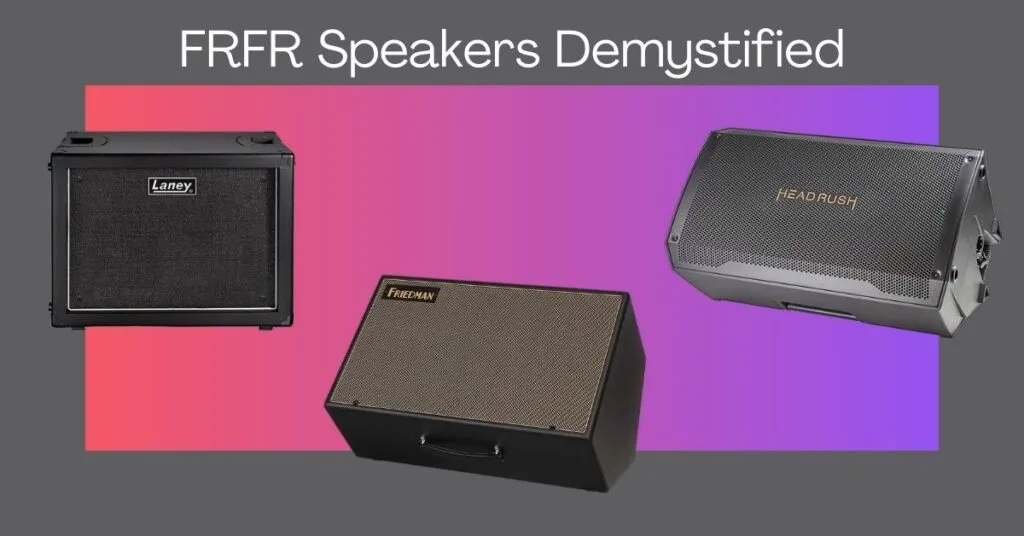
Functional Purpose and Application Context
- Stage monitors are primarily designed for live sound reinforcement, allowing performers on stage to hear themselves and other band members clearly during a performance. They are often wedge-shaped and placed on the floor, angled toward the performers.
- These monitors emphasize vocal clarity and instrumental separation, with frequency responses tailored to highlight midrange frequencies crucial for vocals and lead instruments in a noisy stage environment.
- In contrast, full-range, flat-response (FRFR) speakers aim to deliver an accurate and uncolored representation of the audio signal, making them ideal for both studio monitoring and live use with digital modelers or playback systems that require transparency.
Frequency Response and Sonic Characteristics
- Stage monitors typically feature a shaped frequency response designed to increase intelligibility on stage, often boosting the midrange between 2 kHz and 6 kHz to help vocals cut through stage noise.
- They may roll off extreme low and high frequencies to prevent muddiness or harshness in live settings and to avoid feedback issues from high sound pressure levels near microphones.
- FRFR speakers, by design, maintain a linear frequency response across the audible spectrum, ensuring that the audio source—such as modelers, keyboards, or backing tracks—reproduces exactly as intended, without tonal coloration.
Use with Amplifier Modeling and Signal Sources
- In modern live applications, FRFR speakers are commonly paired with guitar and bass amp modelers, which emulate the tone and response of traditional amplifier cabinets, requiring a neutral speaker to avoid double processing.
- Since stage monitors are frequently used with microphones and analog inputs, they are optimized for handling dynamic mic-level signals and powering through dense stage mixes rather than reproducing pre-processed, line-level modeler outputs.
- Using a stage monitor with an amp modeler can result in an overly colored sound, as the monitor’s natural EQ curve conflicts with the intended cabinet simulation, whereas FRFR speakers preserve the integrity of the modeled tone.
What is the 38 rule in studio monitor placement and how does it impact FRFR accuracy?
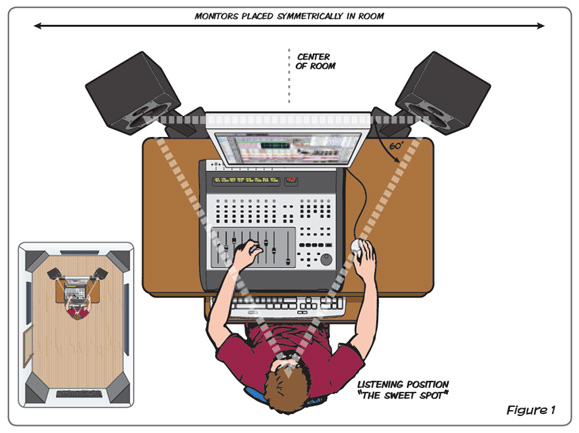
The 38 Rule in studio monitor placement refers to a general guideline suggesting that studio monitors should be positioned 38% of the room’s length from the front wall to minimize the impact of room modes and standing waves on sound reproduction. This placement aims to reduce low-frequency resonances that occur due to the interaction between sound waves and parallel surfaces in a typical rectangular room.
By situating the monitors—and the listening position—according to this fractional distance, engineers seek to locate a sweet spot where frequency response is more balanced, particularly in the critical lower spectrum. This rule is especially relevant for achieving accurate Frequency Response Flatness and Reproduction (FRFR), which is essential in mixing and mastering environments requiring a neutral and truthful sonic representation.
 Studio Monitor Vs Speakers
Understanding the Science Behind the 38 Rule
- The 38 Rule is derived from room acoustics research that identifies positions within a rectangular space where early reflections and axial modes—especially those affecting bass frequencies—tend to cause the least amount of interference. By placing the listening position at approximately 38% of the room’s length from the front wall, it avoids common modal cancellation and reinforcement points, particularly the strong pressure build-up near walls and corners.
- Room modes are standing waves that form between parallel surfaces. These waves can exaggerate or cancel specific frequencies based on their wavelength and the room’s dimensions. Placing monitors and the listening position at 38% helps distribute these modal effects more evenly across the frequency spectrum, avoiding severe dips or peaks localized at certain frequencies.
- While not a universal solution, the 38% point is a starting point for many acoustic measurement and room optimization systems. It works best in conjunction with additional acoustic treatments and measurement tools such as real-time analyzers (RTAs) and measurement microphones to fine-tune the monitoring environment.
How the 38 Rule Enhances FRFR Accuracy
- Flat Frequency Response and Flat Reproduction (FRFR) are crucial in studio monitoring, as they allow engineers to make mixing decisions based on what is actually being produced, not on room-induced distortions. The 38 Rule contributes to FRFR accuracy by reducing early reflections and modal interference, leading to a more neutral sound at the listening position.
- When monitors are placed according to the 38% distance, the direct sound from the speakers reaches the listener with minimal interference from delayed reflections off the front and rear walls. This improves the time-domain coherence of sound arrival, which directly influences perceived timbre and spatial accuracy—key aspects of FRFR.
- By minimizing low-mid frequency anomalies (especially in the 60–200 Hz range where room modes are most problematic), the 38 Rule enables a more consistent translation of bass content across different playback systems, which is a hallmark of high FRFR accuracy.
Limitations and Considerations When Applying the 38 Rule
- The 38 Rule assumes a standard rectangular room with rigid, reflective boundaries. In irregularly shaped rooms, rooms with non-parallel walls, or spaces with significant acoustic absorption, the effectiveness of this rule may diminish, requiring more nuanced placement strategies based on actual acoustic measurements.
- Room proportions play a vital role in determining optimal placement. Some room ratios, such as the golden ratio or other acoustically favorable dimensions, may yield better results with slightly different listening positions; thus, the 38% guideline should be treated as a reference, not a rigid rule.
- Practical constraints such as furniture layout, control surface size, and available space often prevent ideal implementation of the 38 Rule. In such cases, using bass traps, diffusers, and digital room correction systems becomes necessary to compensate for suboptimal placement and maintain FRFR integrity.
What are the advantages of using a FRFR speaker over studio monitors?

Accurate Frequency Response in Live Environments
- Full-range, flat-response (FRFR) speakers are engineered to reproduce sound with minimal coloration, ensuring that audio played through them remains true to the source across all frequencies.
- Unlike many studio monitors that are optimized for acoustically treated spaces, FRFR systems perform reliably in a variety of live settings, such as stages, rehearsal rooms, or untreated venues, where reflections and room modes can distort sound.
- Their flat frequency response makes FRFR speakers ideal for monitoring backing tracks, electronic instruments, or vocal loops during live performances without introducing resonant peaks or cancellations common with conventional PA speakers.
Portability and Durability for On-the-Go Use
- FRFR speakers are typically designed with portability in mind, often featuring lightweight materials, compact enclosures, and built-in handles, making them easy to transport between gigs, studios, or rehearsal spaces.
- Many models come with rugged construction, protective grilles, and weather-resistant materials that withstand the rigors of live performance and frequent setup/teardown cycles, unlike most studio monitors built for static placement.
- Integrated amplification and input options (such as XLR, TRS, and digital connectivity) allow FRFR speakers to operate as standalone systems without external gear, increasing their flexibility in mobile setups.
Consistent Sound Monitoring Across Different Spaces
- Studio monitors excel in controlled, isolated environments but can sound drastically different when moved to non-treated rooms due to their sensitivity to acoustic conditions, whereas FRFR speakers maintain consistent output regardless of environment.
- Artists and engineers using digital audio workstations (DAWs) live or in project studios benefit from the neutral reproduction of FRFR systems, which help identify mix issues that might not be apparent on colored speakers.
- When multiple FRFR speakers are used in different locations (e.g., stage and front-of-house), they provide a coherent and uniform sound image, enabling performers and sound technicians to make reliable audio decisions across the venue.
Frequently Asked Questions
What is the main difference between a studio monitor and FRFR speaker?
Studio monitors are designed for accurate audio reproduction in recording environments, emphasizing flat frequency response. FRFR (Full Range Flat Response) speakers also aim for neutrality but are built to handle amplified instruments and live sound. While both prioritize clarity, FRFRs are more durable and portable for stage use, whereas studio monitors are optimized for critical listening in controlled acoustic spaces.
Can I use a studio monitor as a FRFR speaker in live performances?
While studio monitors provide accurate sound, they are not ideal for live use as FRFR speakers. They lack the durability, power handling, and projection needed on stage. Studio monitors are designed for near-field listening in studios, not for projecting sound to an audience. Using them live may result in poor volume levels, damage from high input, and inadequate dispersion for larger spaces.
Are FRFR speakers suitable for music production in a studio?
FRFR speakers can be used for music production, especially if portability and multi-source input are needed. However, they may not offer the same detailed acoustic precision as dedicated studio monitors in a treated room. While their flat response helps, room acoustics and placement play a bigger role. For critical mixing and mastering, professional studio monitors in a controlled environment are still the preferred choice.
 Studio Monitor Wall Mounts
Why do guitarists use FRFR speakers instead of traditional amps?
Guitarists use FRFR speakers to accurately reproduce the output of modelers and amp simulators without coloration. Traditional amps shape the tone, but FRFRs provide a neutral platform, ensuring the modeled sound remains intact. This is ideal for consistency across venues and recordings. FRFR systems are also lighter and more versatile, allowing direct connectivity to PA systems and greater control over the final sound.
Leave a Reply