
Car Audio Amplifier 1000W

A 1000-watt car audio amplifier transforms any vehicle into a mobile concert hall, delivering powerful, crystal-clear sound that standard factory systems simply can't match.
Designed for audiophiles and bass enthusiasts, these high-performance amplifiers provide the necessary power to drive subwoofers, midrange speakers, and tweeters with precision and authority. Whether you're cruising down the highway or parked at a showcase, a 1000W amplifier ensures deep bass response, dynamic range, and rich audio detail.
Modern models feature advanced thermal protection, variable crossovers, and efficient Class D technology, balancing power with reliability. With the right setup, a 1000W car amplifier unlocks the full potential of your sound system, elevating your listening experience to professional levels.
 Atmos Speaker Installation
What to Know About 1000W Car Audio Amplifiers
A 1000W car audio amplifier is a high-performance device designed to significantly boost the sound output of a car's audio system, delivering powerful, deep bass and crystal-clear highs for an immersive listening experience.
While the stated wattage often refers to peak or maximum power, it's essential to pay attention to the RMS (Root Mean Square) rating, which indicates the continuous power output and offers a more accurate measure of real-world performance. These amplifiers are ideal for audiophiles and music lovers who demand high volume levels without distortion, especially when using subwoofers or full-range speakers in custom sound setups.
Most 1000W amplifiers are Class D, known for their high efficiency and compact size, making them suitable for vehicle installations where space and power consumption are important considerations. Proper installation—including adequate power supply, grounding, and heat dissipation—is critical to ensure optimal performance and longevity.
Types and Classes of 1000W Car Amplifiers
1000W car amplifiers typically come in different classes, with Class D being the most common due to its high efficiency and minimal heat generation.
 Audio Speaker Installation
These amplifiers are ideal for driving subwoofers and can support configurations such as mono, 2-channel, or 5-channel setups depending on the audio system's needs. A mono amplifier is often preferred for subwoofer applications because it delivers concentrated power to a single channel, maximizing bass response.
In contrast, a 2-channel or 5-channel 1000W amplifier can power multiple speakers and subwoofers simultaneously, although the total wattage is distributed across the channels. Understanding the amplifier class and channel configuration helps users match the amplifier to their speaker setup and ensures compatibility and optimal sound quality.
Installation Requirements and Power Considerations
Installing a 1000W car amplifier demands careful attention to the vehicle’s electrical system. These amplifiers draw substantial current and therefore require a high-output alternator, proper gauge wiring (typically 4-gauge or lower), and a secure ground connection to function safely and efficiently.
An inadequate power supply can lead to voltage drops, distortion, or even damage to the amplifier and other electronic components.
 Average Cost Of Car Speaker Installation
It is also recommended to install an inline fuse close to the battery to protect against short circuits. Additionally, users may need a capacitor to stabilize power delivery during sudden bass hits, ensuring consistent performance. Professional installation is often advised to avoid electrical hazards and ensure compliance with manufacturer specifications.
Top Features to Look for in a 1000W Amplifier
When selecting a 1000W car audio amplifier, several key features can influence performance and usability. Look for built-in low-pass and high-pass crossovers, which allow you to filter frequencies and direct appropriate signals to subwoofers or full-range speakers.
RCA inputs and outputs offer flexible integration with head units and additional amplifiers, while remote bass control enables real-time volume adjustment from the driver’s seat. Thermal and overload protection circuits help safeguard the amplifier under heavy usage.
Modern models may also offer Bluetooth connectivity or digital signal processing (DSP) for advanced sound tuning. Ensuring the amplifier has a solid aluminum casing for heat dissipation further contributes to long-term reliability.
 Banana Plug Speaker Wire Install
| Feature | Description | Importance |
|---|---|---|
| RMS Power Output | Measures continuous power; look for at least 500–700W RMS per channel for true performance. | High – More accurate than peak power ratings. |
| Class D Technology | Provides high efficiency, less heat, and compact design. | Essential – Standard in most high-wattage car amps. |
| Signal-to-Noise Ratio (SNR) | Indicates audio clarity; higher values (≥80dB) mean cleaner sound. | High – Reduces background noise and distortion. |
| Build-in Crossover | Allows frequency filtering for optimized speaker performance. | Important – Enhances sound quality and speaker protection. |
| Thermal Protection | Shuts down amplifier if overheating occurs. | Crucial – Prevents damage during extended use. |
Comprehensive Guide to 1000W Car Audio Amplifiers: Features, Installation, and Performance
What 1000W car audio amplifier is best for 1000 watt speakers?
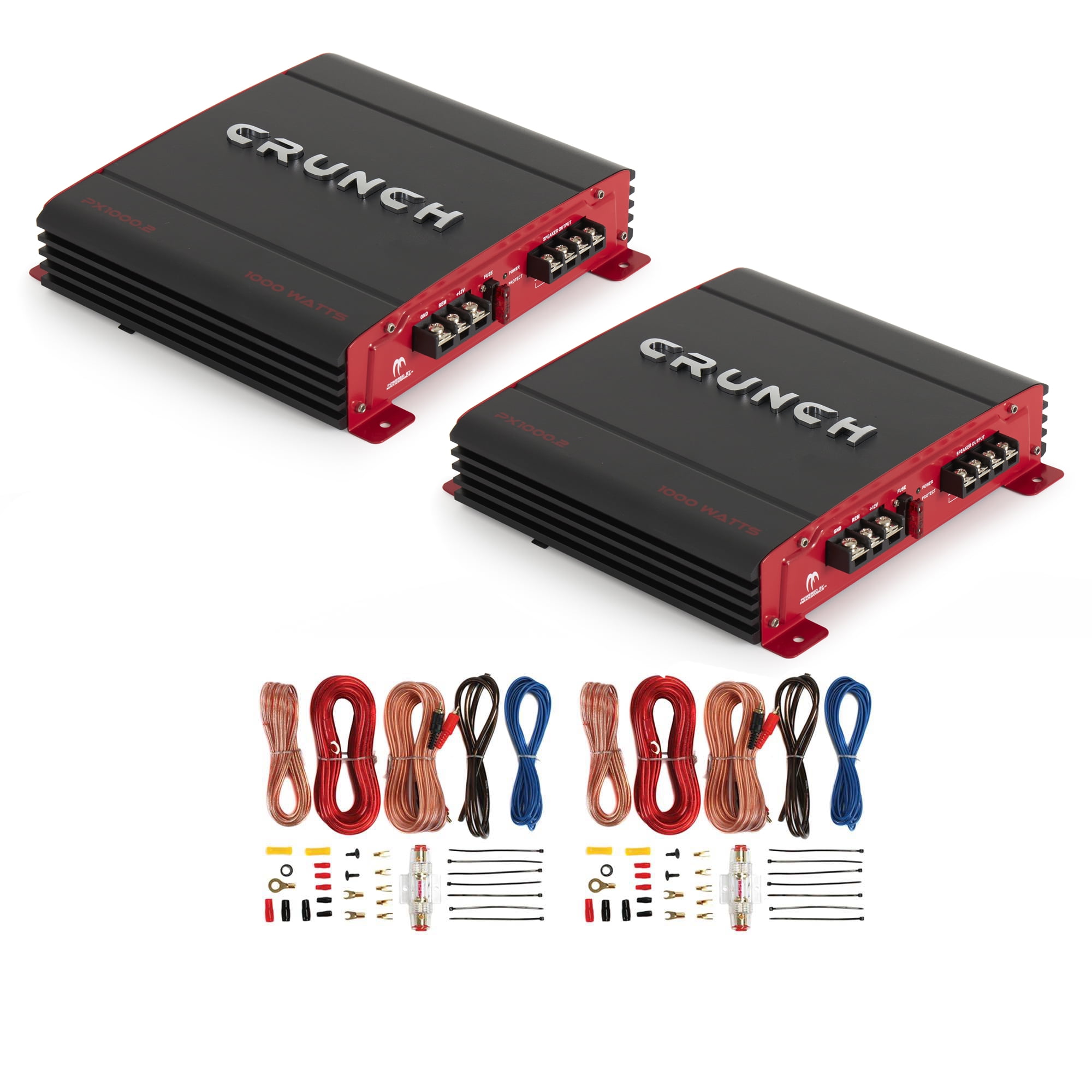
When matching a 1000W car audio amplifier with 1000 watt speakers, the best choice is an amplifier that can deliver clean, stable power at the speaker's impedance (typically 2 or 4 ohms) without distortion.
Monoblock amplifiers such as the Rockford Fosgate T1000-1bdCP or the Kicker CXA1000.1 are excellent choices for subwoofers, while multi-channel high-power amplifiers like the Alpine MRV-M1000 or the JBL CLUB9004 offer flexibility for full-range systems.
Class D amplifiers are preferred due to their high efficiency and compact size. Crucially, the amplifier should provide RMS power output close to 1000 watts at the same impedance as the speakers, ensuring optimal performance and preventing under or over-powering. Build quality, thermal protection, and signal-to-noise ratio also contribute significantly to long-term reliability and sound clarity.
 Berman Speaker Installation
Top 1000W Amplifier Brands for Matching with 1000W Speakers
- Rockford Fosgate is renowned for its durable amplifiers that deliver consistent power; models like the T1000-1bdCP are optimized for deep bass and are stable at low impedances, ensuring compatibility with 1000W subwoofers.
- Kicker amplifiers, such as the CXA1000.1, offer excellent value with reliable thermal management and low distortion, making them a strong match for high-output audio systems.
- Alpine’s MRX-M1000 uses advanced filtering and high-current power supplies to deliver clean 1000W RMS output, ideal for audiophiles seeking precision and dynamic headroom.
Key Technical Features to Consider in a 1000W Car Amplifier
- Ensure the amplifier provides 1000W RMS (not peak power) at the same impedance—usually 1 or 2 ohms—as your speakers to prevent clipping and potential damage.
- Look for built-in low-pass filters, bass boost controls, and adjustable input sensitivity to fine-tune audio output and seamlessly integrate with factory or aftermarket head units.
- Thermal and short-circuit protection mechanisms are essential to maintain amplifier longevity, especially in high-load scenarios such as extended bass-heavy playback.
Installation and Power Requirements for 1000W Systems
- A 1000W amplifier typically requires a 4-gauge or larger power wire, a high-output alternator, and often an additional battery or capacitor to maintain stable voltage under load.
- Proper grounding is critical—use a short, direct connection to the vehicle chassis to avoid hum and ensure efficient power delivery.
- Routing speaker wires away from signal cables prevents interference, and using high-density insulation on power cables reduces voltage drop and overheating risks.
What is the ideal wattage for a high-performance 1000W car audio amplifier?
The term 1000W car audio amplifier typically refers to an amplifier that is capable of delivering up to 1000 watts of total power output, usually distributed across multiple channels.
However, the ideal wattage for a high-performance system depends not just on the stated power rating, but on how that power is delivered, the efficiency of the components, and the demands of the listening environment. A true high-performance 1000W amplifier should provide stable, clean power output across its frequency range without distortion, especially when driving low-impedance loads.
It’s important to note that many manufacturers advertise peak or maximum power, which can be misleading. The ideal amplifier for high performance will have a continuous (RMS) power output close to or matching 1000 watts, with minimal total harmonic distortion (THD), good signal-to-noise ratio (SNR), and solid thermal and electrical management.
Understanding RMS vs. Peak Power in 1000W Amplifiers
- RMS (Root Mean Square) power indicates the continuous power an amplifier can deliver over time without overheating or distorting, making it the most reliable measure of performance. For a high-performance 1000W amplifier, the RMS output should be clearly specified and close to 1000 watts across all channels when driven at a stable impedance, such as 2 or 4 ohms.
- Peak power, often advertised prominently, refers to the maximum short-term burst an amplifier can handle during high-demand musical passages. This number is typically much higher than RMS and can be misleading if used to judge real-world performance.
- To ensure optimal performance, users should compare RMS ratings under the same load conditions (e.g., 4 ohms, 2 ohms) and frequency ranges. A true 1000W RMS amplifier will deliver consistent power across all channels simultaneously without channel crosstalk or degradation in sound quality.
Matching Amplifier Wattage to Speaker Specifications
- For a high-performance audio system, it’s critical that the amplifier’s output closely matches the speakers’ or subwoofers' power handling capabilities. Ideally, the amplifier’s RMS output should be within 75% to 100% of the speaker’s RMS handling rating to prevent damage from underpowering or overpowering.
- Using a 1000W amplifier with speakers rated for much less power increases the risk of distortion and mechanical failure, especially if gain levels are improperly set. Conversely, underpowering high-sensitivity speakers can result in clipping and poor dynamic range, even if the amplifier is labeled 1000W.
- When designing a system, consider how power is distributed—whether the 1000W is total power across multiple channels or dedicated to a single subwoofer. A monoblock amplifier designed for subwoofers might deliver 1000W cleanly into 1 ohm, while a multi-channel amplifier may only deliver 250W per channel at 4 ohms, totaling 1000W.
Electrical and Thermal Considerations for Sustained 1000W Output
- Delivering clean, stable 1000W of audio power requires substantial electrical input. The vehicle’s alternator and battery must support the increased current draw, typically requiring an upgraded electrical system, including high-output alternators, additional batteries, or capacitor installations.
- High-performance amplifiers generate significant heat, especially when operating near full capacity for extended periods. Efficient thermal management through robust heatsinks, forced-air cooling, or advanced circuit design (such as Class D topology) is essential to maintain performance and reliability.
- Poor thermal or electrical design can cause voltage drops, thermal shutdown, or premature component failure. Look for amplifiers with over-temperature, over-voltage, under-voltage, and short-circuit protection to ensure long-term durability under heavy load conditions.
What Battery Size Is Required for a 1000W Car Audio Amplifier?
Understanding Power Requirements for a 1000W Car Audio Amplifier
To determine the appropriate battery size for a 1000W car audio amplifier, it's essential to understand the amplifier's true power consumption.
 Best Buy Car Speaker Installation Cost
The advertised 1000W output typically refers to peak or RMS power, but the electrical draw from the car's battery depends on efficiency and voltage. Most car audio amplifiers operate on 12-volt systems, but due to inefficiencies, especially in Class AB amplifiers, the actual current draw can be significantly higher than expected.
Assuming an efficiency of around 70–80%, a 1000W amplifier may draw approximately 100 to 120 amps from the battery under full load. This means the vehicle’s electrical system must support sustained current delivery without draining the battery or overloading the alternator.
- Calculate the current draw using the formula: Current (Amps) = Power (Watts) / Voltage (Volts). For a 1000W amplifier at 12V, this results in roughly 83 amps, but real-world losses increase this number.
- Consider amplifier class—Class D amplifiers are more efficient (up to 90%), requiring less current compared to Class AB (60–70% efficiency), which increases the battery demand.
- Factor in the duration of high-power usage; continuous bass-heavy music requires longer sustained power delivery, placing greater strain on the battery and charging system.
Recommended Battery Specifications and Capacity
The battery size needed for a 1000W amplifier isn't measured in physical dimensions but in electrical capacity, typically expressed in ampere-hours (Ah) and cold cranking amps (CCA). A standard car battery (around 40–60 Ah) may suffice for short bursts, but sustained high-power operation demands a higher-capacity battery or supplemental power sources.
Deep-cycle batteries, which are designed for repeated discharge and recharge cycles, are often recommended for high-wattage audio systems. AGM (Absorbent Glass Mat) batteries are particularly well-suited due to their high reserve capacity, low internal resistance, and ability to handle deep discharges without significant degradation.
 Best Buy Car Speaker Installation Price
- Select a battery with at least 80–100 Ah capacity to handle prolonged amplifier use and reduce the risk of voltage drops.
- Choose an AGM or dual-purpose deep-cycle battery to ensure reliable performance and faster recharge rates compared to traditional flooded lead-acid batteries.
- Verify the battery’s reserve capacity (RC)—a rating above 120 minutes indicates the battery can deliver steady power over time, crucial for high-draw audio systems.
Supporting Components to Enhance Power Delivery
While battery capacity is crucial, pairing it with the right supporting components ensures optimal performance and protects both the amplifier and vehicle electronics. A high-output alternator (150–200 amps or more) is often necessary to recharge the battery quickly and supply power during amplifier peaks.
Without sufficient alternator output, the battery will deplete over time, even if initially oversized. Additionally, installing a capacitor can help stabilize voltage by providing instantaneous power during bass hits, reducing strain on the battery. Proper wiring gauge is also vital; undersized cables cause voltage drops and overheating, diminishing system efficiency and safety.
- Upgrade to a high-output alternator to maintain system voltage and prevent battery drain during extended amplifier use.
- Add a car audio capacitor (1–2 Farads) near the amplifier to buffer short-term power demands and prevent headlight dimming.
- Use power and ground cables of at least 1/0 AWG gauge for a 1000W system to minimize resistance and ensure efficient current flow from battery to amplifier.
Frequently Asked Questions
What is the power output of the Car Audio Amplifier 1000W?
The Car Audio Amplifier 1000W delivers a maximum power output of 1000 watts, providing strong, clear sound for car audio systems. It typically offers RMS power around 400-600 watts depending on impedance, ensuring stable performance. This high output makes it ideal for driving subwoofers and speakers with deep bass and minimal distortion, even at high volumes.
Does the 1000W amplifier work with all car audio systems?
The 1000W amplifier is compatible with most car audio systems, especially those with aftermarket speakers or subwoofers. It supports common impedance levels like 2 or 4 ohms. However, ensure your vehicle’s electrical system can handle the power demand. Proper wiring and a sufficient battery or capacitor may be needed to prevent voltage drops and ensure smooth integration with your existing setup.
 Best Buy Ceiling Speaker Installation
How do I install the Car Audio Amplifier 1000W in my vehicle?
To install the Car Audio Amplifier 1000W, mount it securely in a dry, ventilated area, connect the power wire to the battery, and ground it to the chassis. Use RCA cables to link it to the head unit, connect speaker wires, and ensure all connections are tight. Always disconnect the battery before starting and follow the included manual for model-specific instructions.
Does the amplifier have built-in protection features?
Yes, the Car Audio Amplifier 1000W includes built-in protection circuits such as thermal, overload, and short-circuit protection. These features safeguard the amplifier from overheating, electrical faults, and damage due to improper wiring. This ensures long-term reliability and performance stability, especially during extended use or high-volume playback, making it a durable choice for demanding car audio environments.
Leave a Reply