
Mixer How To Connect A Powered Subwoofer To Passive Speakers

Connecting a powered subwoofer to passive speakers can significantly enhance your audio setup by adding depth and clarity to low-frequency sounds.
This configuration is common in home theaters, studios, and high-fidelity listening environments where full-range sound reproduction is essential. A powered subwoofer includes its own amplifier, making it easier to integrate into systems without additional amplification for the low end.
Proper connection ensures seamless blending between the subwoofer and passive speakers, avoiding frequency gaps or overlaps. This guide explains the necessary cables, signal routing options, and settings adjustments to achieve optimal performance and balanced sound distribution across your entire audio system.
 How To Connect Speakers To PC With Aux
How to Connect a Powered Subwoofer to Passive Speakers Using a Mixer
Connecting a powered subwoofer to passive speakers via a mixer allows you to enhance your audio setup with deeper bass response while leveraging the amplifier built into the subwoofer and the passive speakers' full-range sound.
This configuration is common in live sound reinforcement, home studios, and stage setups, where you need clear low-frequency extension without using additional external amplifiers for the passive speakers. To achieve this, the mixer routes the low-frequency signals to the powered subwoofer, while the higher frequencies are sent to the passive speakers either directly or through a crossover network.
Proper cabling and mixer settings are essential to prevent phase issues, signal loss, or equipment damage. By following the correct signal chain workflow and understanding key audio principles, you can integrate the subwoofer seamlessly into your passive speaker system for a balanced, full-range sound output.
Signal Path and Crossover Setup
Establishing the correct signal path is fundamental when connecting a powered subwoofer to passive speakers using a mixer.
 How To Connect Speakers To Record Player
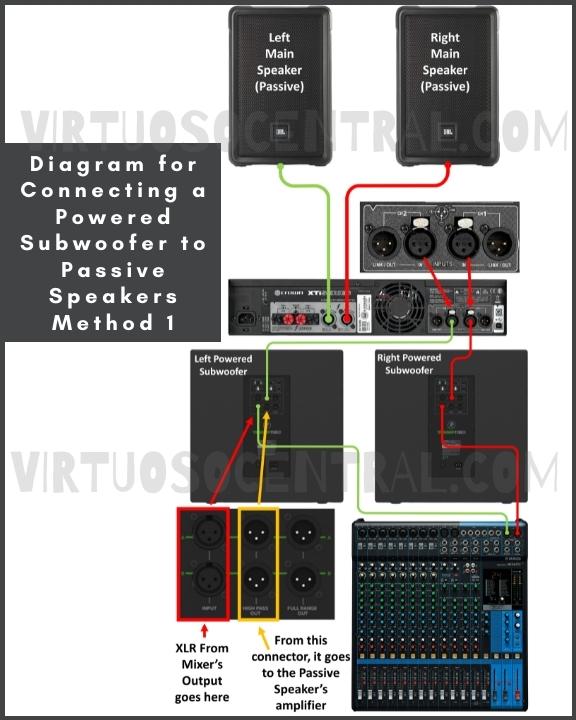
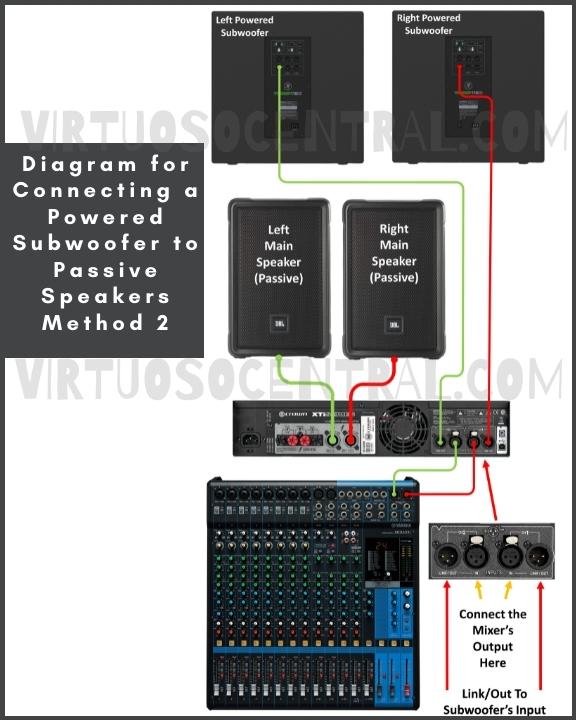
Start by sending the main output (often labeled Main Out or L/R Out) from the mixer to the powered subwoofer’s input, typically via XLR or 1/4 cables. Most powered subwoofers feature a built-in crossover that filters out high frequencies, allowing only the low-end signals (usually below 80–120 Hz) to be amplified and reproduced.
The subwoofer then provides a Pass-Through or Line Out (also known as a Sub Out or Thru) that carries the high-passed signal—stripped of bass frequencies—on to the passive speakers. This prevents the passive speakers from reproducing low frequencies they may not handle efficiently. Some mixers also offer built-in crossover processors or auxiliary sends that can be used for more precise control over frequency distribution, especially in professional audio environments.
Proper Cabling and Connection Types
Choosing the right cables and connection types ensures a reliable and high-quality signal transfer between your mixer, powered subwoofer, and passive speakers. Use balanced XLR or TRS cables from the mixer's main outputs to the subwoofer’s inputs to reduce noise and interference, especially over longer cable runs.
The powered subwoofer should have a Line Out or Thru output, typically XLR or 1/4, which connects to the input of an external power amplifier driving the passive speakers—or to an active speaker if repurposed in a hybrid setup. It’s critical to confirm that the subwoofer’s pass-through output is post-crossover (high-passed), so the passive speakers receive a clean, bass-free signal.
 How To Connect To 2 Speakers At Once iPhone
Avoid using unbalanced cables (like TS or RCA) in professional environments, as they are more prone to picking up hum and radio frequency interference. Always double-check input and output impedance compatibility to prevent loading issues that can degrade sound quality and performance.
Optimizing Mixer and Subwoofer Settings
To achieve a seamless blend between the powered subwoofer and passive speakers, proper configuration of your mixer and subwoofer controls is essential. Begin by setting the subwoofer’s crossover frequency to match the low-frequency roll-off point where the passive speakers begin to lose efficiency—commonly around 80 Hz.
Adjust the phase switch on the subwoofer (0° or 180°) to align the sub’s sound wave with those of the passive speakers and avoid cancellation effects, especially in the critical low-mid region. On the mixer, ensure that the main output levels are set conservatively to prevent clipping when the signal reaches the subwoofer's internal amplifier.
Use the mixer’s EQ or graphic equalizer to adjust any frequency buildup, especially in the 100–200 Hz range, which can muddy the overall sound. Lastly, apply gain staging throughout the chain: set input gains on the mixer properly, match output levels between devices, and use the subwoofer’s volume control to blend the bass level with the output of the passive speakers for a cohesive audio experience.
 How To Connect To Ceiling Speakers
| Component | Connection Type | Key Settings | Recommended Practice |
|---|---|---|---|
| Mixer | Main Out (XLR/1/4”) → Subwoofer | Output level: 0 dB, Balanced signal | Use balanced outputs to minimize noise |
| Powered Subwoofer | Input: XLR/TRS, Output: Line Out (XLR) | Crossover freq: 80 Hz, Phase: 0° or 180° | Enable pass-through and set crossover correctly |
| Passive Speakers | Connected via amp from sub’s Line Out | Amplifier gain matched to mixer/sub output | Use external amp if speakers are passive |
| Signal Chain | Mixer → Sub → Amp → Passive Speakers | No bass sent to passive speakers | Verify high-passed signal reaches amp input |
How to Connect a Powered Subwoofer to Passive Speakers: A Step-by-Step Guide
How to Connect a Powered Subwoofer to Passive Speakers Using a Mixer
To connect a powered subwoofer to passive speakers using a mixer, you need to ensure that the audio signal is properly routed so that low frequencies are sent to the subwoofer while the full-range or high-mid frequencies are delivered to the passive speakers.
The mixer acts as the central hub for managing the signal flow. Begin by connecting your audio source (e.g., smartphone, laptop, or turntable) to the input channels on the mixer. From the mixer’s main output (typically XLR or TRS), send the signal to a powered subwoofer that features both input and output (through) connectors.
After connecting to the subwoofer's input, use the subwoofer's line-level output (often labeled Speaker Out, Pass Through, or Satellite Out) to link to the input of your power amplifier. Finally, connect your passive speakers to the outputs of the power amplifier. Make sure the subwoofer’s crossover is adjusted so it only reproduces low frequencies, allowing the passive speakers to handle mid and high frequencies without strain.
Understanding Signal Flow and Equipment Roles
- The mixer combines and processes audio signals from various sources, allowing level and tone adjustments before sending the audio down the chain. Its main output sends a balanced line-level signal suitable for external processing.
- The powered subwoofer receives this line-level signal, uses its built-in amplifier to drive the subwoofer driver, and filters low frequencies using its internal crossover. Crucially, it also passes the remaining frequencies (high-passed signal) through its output terminals.
- Because passive speakers lack internal amplification, they require a separate power amplifier. The signal exiting the subwoofer’s pass-through output must be sent to this amplifier, which then powers the passive speakers with the appropriate amount of current.
Setting Up Connections Step by Step
- Start by connecting your audio source (e.g., CD player or microphone) to an input channel on the mixer using XLR, TRS, or RCA cables, depending on the available ports.
- Take a balanced cable (XLR or 1/4 TRS) from the mixer’s main output and connect it to the line-level input on the powered subwoofer. This delivers the full-range signal for processing.
- Use another line-level cable to connect the subwoofer’s output (often labeled “To Satellite,” “Passive Out,” or “L/R Out”) to the input of your external power amplifier. Then connect speaker wires from the amplifier's terminals to the passive speakers, observing correct polarity and impedance matching.
Optimizing Crossover and Volume Settings
- Adjust the crossover frequency on the powered subwoofer (typically between 80–120 Hz) based on the frequency response of your passive speakers. This ensures a smooth transition between the subwoofer and the main speakers.
- Set the subwoofer’s input sensitivity or level control to match the output level of the mixer. Begin with the knob at around 50% and fine-tune during testing to avoid overpowering the mix.
- Balance the volume between the subwoofer and the passive speakers by playing reference music with strong bass content. Adjust both the subwoofer level and the power amplifier gain until the sound is cohesive and free from frequency gaps or overlap.
Can you connect passive speakers to a powered subwoofer using a mixer?
 How To Connect Two JBL Speakers To Each Other
Yes, you can connect passive speakers to a powered subwoofer using a mixer, but the setup requires careful signal routing and compatibility considerations.
Generally, a powered subwoofer has its own built-in amplifier and is designed to handle low-frequency signals, while passive speakers need an external amplifier to function. The mixer acts as a central hub to blend audio sources and distribute signals. You would typically send the main output from the mixer to the powered subwoofer's line input.
If the subwoofer has a line/pass-through output (often labeled as Speaker Level Out or Line Out to Satellites), this can be used to send a high-passed or full-range signal to an external power amplifier, which then drives the passive speakers. It's crucial that the power amplifier matches the impedance and power requirements of the passive speakers to avoid damage. This configuration is common in small to mid-sized audio setups where a full active speaker system isn’t available.
Signal Flow and Mixer Output Considerations
- The mixer's main output (usually XLR or 1/4 TRS) should be connected to the line input of the powered subwoofer. This sends the full-range or mixed audio signal to the subwoofer for low-frequency processing.
- Many powered subwoofers include a built-in crossover that separates bass frequencies for the sub and routes the remaining frequencies out through a pass-through or satellite out jack. This output carries a high-passed signal suitable for full-range or mid/high speakers.
- Since passive speakers cannot be connected directly to a subwoofer’s line-level pass-through outputs, the signal from the subwoofer’s satellite out must first go to an external power amplifier. The amplifier then powers the passive speakers with a suitable high-level signal.
Compatibility of Passive Speakers and Amplification Requirements
- Passive speakers lack internal amplifiers, so they depend entirely on an external amplifier to convert line-level signals into speaker-level signals capable of driving the speaker drivers.
- When integrating passive speakers into a system with a powered subwoofer, it’s essential to select an amplifier that matches the speaker’s impedance (typically 4, 6, or 8 ohms) and power handling (measured in watts RMS) to ensure clean sound and avoid overheating or distortion.
- The amplifier should be placed between the powered subwoofer’s pass-through output and the passive speakers. This setup allows the subwoofer to manage the bass while the external amplifier energizes the mid and high frequencies on the passive speakers.
Practical Setup Examples and Wiring Configuration
- Start by routing the mixer’s main L/R outputs to the powered subwoofer’s input using balanced cables (XLR or TRS) to minimize noise and interference, especially over longer cable runs.
- Connect the subwoofer’s satellite or line-level output to the input of an external stereo power amplifier. This signal is typically filtered to remove bass frequencies, so the amplifier only sends mid and high frequencies to the passive speakers.
- Link the power amplifier’s output terminals to the passive speakers using appropriate speaker wire, observing correct polarity (positive to positive, negative to negative) to maintain phase alignment across the system.
How to connect a powered subwoofer to a mixer with passive speakers?
 How To Connect Two Speakers To One iPhone
Understanding Signal Flow: Connecting Mixer to Powered Subwoofer
To correctly connect a powered subwoofer to a mixer alongside passive speakers, you must first understand the signal path. The mixer processes all audio inputs and outputs a mixed signal, which needs to be routed to the powered subwoofer before reaching the passive speakers.
Most powered subwoofers feature input options such as line-level inputs (RCA or XLR) and sometimes speaker-level inputs. However, for optimal control and sound quality, a line-level connection is preferred. This setup allows the subwoofer's built-in crossover to manage low frequencies effectively.
- Locate the main output or control room output on your mixer, preferably balanced XLR or TRS outputs for better noise rejection.
- Use balanced audio cables (XLR or TRS) to connect the mixer’s output to the line-level input on the powered subwoofer.
- Ensure the subwoofer’s input sensitivity or level control is properly adjusted to match the mixer’s output level to prevent distortion or weak signal.
Routing the Signal to Passive Speakers from the Subwoofer
Many powered subwoofers include a pass-through or line-out feature, often labeled as Sub Out, Speaker Out, or To Speakers.
This output sends the remaining full-range or high-passed signal (after the subwoofer has extracted the low frequencies) to the power amplifier that drives the passive speakers. This method maintains a clean chain and prevents the need for additional signal splitting. It's essential that the subwoofer has this feature; otherwise, a different routing strategy is needed.
 How To Connect Wireless Microphone To Speakers
- Check if the powered subwoofer has a speaker-level output or a line-level output labeled for sending signal to external amplifiers or full-range speakers.
- If using a line-level pass-through, connect it to the input of a separate power amplifier using an XLR or TRS cable, then connect the amplifier to the passive speakers with appropriate speaker wire.
- If the subwoofer has speaker-level outputs, you may directly connect these to the passive speakers using standard speaker cables, provided the impedance and power ratings are compatible.
Setting Crossover and Phase for Optimal Integration
Proper crossover and phase settings are critical when integrating a powered subwoofer with passive full-range speakers. The crossover determines the frequency at which the subwoofer stops producing higher frequencies and allows the main speakers to handle them.
Most powered subwoofers allow you to adjust this point via a crossover frequency knob, typically set between 80 Hz and 120 Hz depending on the speaker size and room acoustics. Additionally, the phase control helps align the timing of the subwoofer’s output with that of the main speakers to avoid cancellation.
- Adjust the crossover frequency on the subwoofer so that it complements the low-frequency response of your passive speakers; smaller speakers may require a higher crossover point.
- Use the phase switch or continuous phase control to align the subwoofer’s sound wave with the main speakers; you can test this by playing bass-heavy music and adjusting for maximum low-end reinforcement.
- Use test tones or a real-time analyzer app if available to fine-tune the transition between the subwoofer and passive speakers for a smooth frequency response.
Frequently Asked Questions
How do I connect a powered subwoofer to passive speakers using a mixer?
Connect the mixer’s main or auxiliary outputs to the powered subwoofer’s line input using RCA or 1/4 cables. Then, connect the subwoofer’s speaker-level outputs to the passive speakers using speaker wire. Ensure the mixer’s output signal matches the subwoofer’s input requirements. Set the subwoofer’s crossover frequency to blend smoothly with the passive speakers. Always power off devices during setup to avoid damage.
Can I daisy-chain passive speakers to a powered subwoofer safely?
Yes, you can daisy-chain passive speakers to a powered subwoofer if the subwoofer has speaker-level outputs and supports the total impedance of the connected speakers. Use proper speaker wire to connect the amplifier output on the subwoofer to the first passive speaker, then link additional speakers in parallel or series as recommended. Avoid overloading the subwoofer’s output stage by checking impedance and power ratings.
What cables are needed to connect a powered subwoofer and passive speakers?
Use RCA or 1/4 TRS cables to send the line-level signal from the mixer to the powered subwoofer’s input. Then, use speaker wire to connect the subwoofer’s speaker-level outputs to the passive speakers. Ensure cables are the correct gauge and length for minimal signal loss. High-quality shielded cables reduce noise and interference, especially in live or studio environments with many electronic devices.
Should I use line-level or speaker-level connections for the subwoofer?
Use a line-level connection (RCA or 1/4) from the mixer to the powered subwoofer for better signal control and reduced interference. The subwoofer then amplifies this signal internally. Connect passive speakers to the subwoofer’s speaker-level outputs only if it’s designed for such use. Line-level inputs provide cleaner sound and allow precise crossover and volume adjustments, ensuring optimal integration with the passive speaker system.
Leave a Reply